
Client-Side Encryption Explained: What Happens Before Your Data Reaches the Server?
When you upload a sensitive file to the cloud, where does encryption actually happen?
With traditional cloud storage, encryption often happens after your data reaches the provider's infrastructure. Client-side encryption changes that model.
Client-side encryption encrypts your data on your device before it reaches the server. The server receives ciphertext instead of readable information. The decryption key stays under user control rather than being available to the storage provider.
That distinction matters for sensitive documents, financial credentials, recovery information, legal records, digital assets, and inheritance instructions.
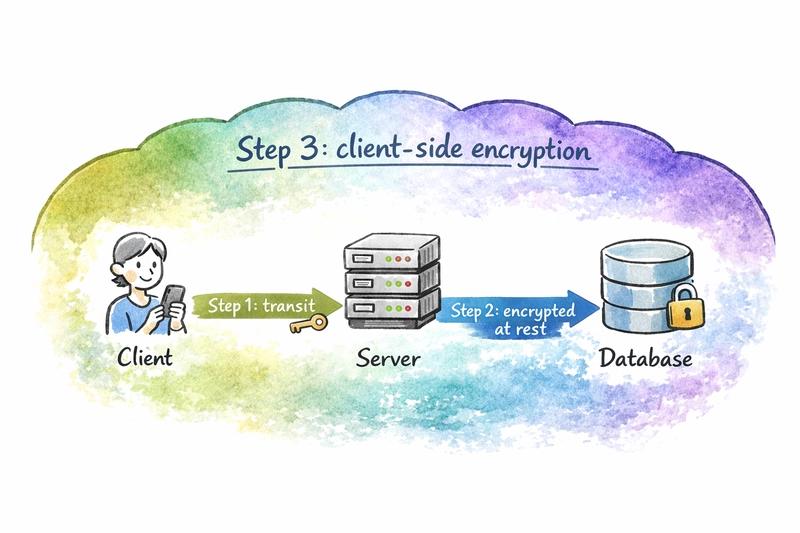
So what happens before your data reaches the server? Your device prepares the encryption key, often by deriving it from your password. It encrypts the file into ciphertext. It then sends only that ciphertext over a TLS-protected connection. The server stores data it cannot read without your key.
Vaultix uses a client-side encryption architecture built around AES-256-GCM. Its public security documentation states that encryption, decryption, and key derivation occur on the client. Vaultix also states that its servers receive encrypted data rather than readable vault content.
This creates a different security boundary. Your cloud provider may store the data. It does not need to possess the ability to read it.
This guide explains what happens before your data reaches the server, how client-side encryption works, how it differs from server-side encryption, and what you should look for in a secure digital vault.
What Is Client-Side Encryption?
Client-side encryption is an encryption model where data is encrypted on the user's device before transmission to a server. The server only stores ciphertext. The decryption key stays with the user or an authorized client. A storage provider can hold your files without being able to read them.
The client can be a browser, desktop application, mobile application, or another trusted endpoint.
The basic process looks like this:
Plaintext data → encryption on your device → ciphertext → secure transmission → server storage
The server stores the encrypted version. To read the original information, an authorized client must have access to the appropriate decryption key.
This differs from many standard cloud storage systems. In a server-side encryption model, data can reach the provider before encryption occurs.
Both approaches can provide strong security. They protect against different risks. Client-side encryption changes who controls the encryption boundary.
For Vaultix, this principle is central to its zero-knowledge architecture. Vaultix states that encryption keys remain under user control and that its infrastructure cannot access readable vault content. That architecture is particularly relevant when the information itself is highly sensitive.
Examples include:
- Cryptocurrency recovery phrases
- Private keys
- Financial credentials
- Legal documents
- Estate plans
- Personal identification records
- Confidential business documents
- Digital inheritance instructions
- Recovery information
- Sensitive family records
AWS also documents client-side encryption for Amazon S3. Its S3 Encryption Client encrypts objects before they are sent to S3. AWS states that S3 does not perform the encryption or decryption for those objects.
How Does Client-Side Encryption Work Step by Step?
Client-side encryption works in six steps. You select a file on your device. The client derives or loads an encryption key. It encrypts the file with an authenticated algorithm such as AES-256-GCM. Only the ciphertext travels to the server, which stores it. Later, an authorized client decrypts the data locally. Readable content never needs to appear on the server.
The easiest way to understand client-side encryption is to follow a file from your device to the server.
1. You select the data
Suppose you want to store a confidential legal document. The document starts as readable plaintext on your device. At this point, the file can be opened normally by an authorized application.
2. The encryption process begins locally
The client encryption engine generates or accesses the cryptographic material required for encryption. A strong implementation should not simply use your password as an encryption key. Instead, a key derivation process can transform a password or secret into suitable cryptographic key material.
Vaultix states that key derivation occurs client-side and references PBKDF2 or Argon2 in its security documentation.
3. The file is encrypted
A modern authenticated encryption algorithm converts the readable file into ciphertext. Vaultix states that it uses AES-256-GCM for data at rest.
AES is a widely used symmetric encryption standard. GCM adds authentication to the encryption process. That authentication matters.
Encryption should not only hide the data. It should also help detect unauthorized modification.
OWASP recommends AES with a strong key and secure mode for symmetric encryption. It also stresses that encryption architecture should begin with a clear threat model.
4. Only ciphertext leaves the device
This is the critical step. The readable file should not be sent to the storage server first.
Instead:
Your device creates ciphertext → ciphertext is transmitted → server stores ciphertext
That means a storage provider does not need access to the original plaintext. AWS describes the same basic concept in its S3 client-side encryption documentation.
5. The server stores encrypted data
The storage infrastructure receives encrypted information. The server can still provide storage, availability, synchronization, and other infrastructure services. But the encryption boundary has already been established.
Vaultix describes this as a zero-knowledge architecture. Its public documentation states that its infrastructure cannot access encrypted vault content.
6. The authorized client decrypts the data
When an authorized user opens the information, the client performs the reverse process. The necessary cryptographic material is used to transform ciphertext back into readable information. The important point is that decryption happens on the trusted endpoint.
The server does not need to become the place where readable content appears.
What Happens Before Your Data Reaches the Server?
Before your data reaches the server, three things happen on your side. First, the client prepares an encryption key, often derived from your password or secret. Second, it encrypts the file into ciphertext. Third, it sends that ciphertext through a TLS-protected connection. When the data arrives, the server holds information it cannot read without the key.
This is the part many people miss. Client-side encryption does not mean that your file simply travels through the internet with no protection. A properly designed system normally uses multiple security layers.
The sequence can look like this:
Your file
↓
Client-side encryption
↓
Ciphertext
↓
TLS-protected connection
↓
Encrypted storage
This provides protection at different stages. Client-side encryption protects the information before it reaches the storage provider. TLS protects the network connection during transmission.
Storage encryption provides another layer for data held by the infrastructure. Vaultix states that it uses TLS 1.3 for data traveling between the local device and distributed storage nodes. AWS also notes that client-side encryption can coexist with server-side encryption.
That creates defense in depth. One layer does not have to replace another.
How Is Client-Side Encryption Different From Server-Side Encryption?
Client-side encryption happens on your device before upload, and you or a designated key system control the keys. Server-side encryption happens on the provider's infrastructure after the data arrives. The provider often manages those keys. Client-side offers stronger privacy. Server-side offers easier search, previews, and account recovery.
The biggest difference is where encryption happens and who controls the relevant keys.
|
Feature |
Client-Side Encryption |
Server-Side Encryption |
|
Encryption location |
User device |
Provider infrastructure |
|
Plaintext reaches server |
Designed not to |
Often yes before encryption |
|
Key control |
User or designated key system |
Often provider-controlled |
|
Provider access |
Can be designed to prevent access |
Depends on key architecture |
|
Recovery |
More responsibility for user |
Often easier |
|
Search and processing |
More limited |
Usually easier |
|
Privacy model |
Stronger separation from provider |
Greater provider involvement |
|
Complexity |
Higher |
Usually lower |
Neither model is automatically appropriate for every application. Server-side encryption is easier for many mainstream applications. It allows cloud providers to support indexing, search, previews, analytics, and other services more easily.
Client-side encryption adds stronger separation. But it also creates additional responsibility.
The key question is simple:
Who needs the ability to decrypt the data?
If the answer includes your cloud provider, you have a different trust model. If only authorized users should decrypt it, client-side encryption becomes much more relevant.
Is Client-Side Encryption the Same as End-to-End Encryption?
No, they are not always the same. Client-side encryption describes where encryption happens, which is on the user's device. End-to-end encryption describes who can read the data, which is only the intended endpoints. A system can encrypt on the client while an organization or key service still controls the keys. So always check who holds the keys.
The terms are closely related, but they are not always identical. End-to-end encryption usually describes a system where only the intended endpoints can access plaintext. Messaging applications are a common example.
Client-side encryption describes where the encryption process occurs. Google's current documentation makes an important distinction between its Workspace CSE implementation and traditional end-to-end encryption.
In Google Workspace CSE, encryption occurs on the client. Organizations can also control encryption keys through an external key service. That means "client-side encryption" does not automatically tell you everything about key ownership.
Always ask:
- Where is encryption performed?
- Where is decryption performed?
- Who creates the keys?
- Who stores the keys?
- Can the provider access the keys?
- Can administrators revoke access?
- What happens if a device is lost?
- What happens if the primary user loses access?
Those questions provide a much clearer security picture than the phrase "encrypted" alone.
Why Does Vaultix Use Client-Side Encryption?
Vaultix uses client-side encryption because digital legacy information is extremely sensitive. Wallet details, credentials, and legal documents need protection from server-side access. Its public architecture describes AES-256-GCM encryption on the user's device and a zero-knowledge model. Vaultix pairs this with beneficiary controls, so the right people can gain access later under predefined conditions.
Vaultix is designed around protecting digital assets and digital legacy information. Its public architecture describes client-side AES-256-GCM encryption before data reaches its infrastructure. It also describes a zero-knowledge model where Vaultix cannot access readable vault content.
That approach fits information where privacy is more important than server-side convenience. Vaultix identifies several types of information that can be placed inside its encrypted vault, including cryptocurrency wallet information, credentials, legal documents, and recovery notes. The platform also connects encryption with inheritance planning.
That creates an important distinction from ordinary cloud storage.
A normal cloud drive mainly answers:
"How can I store and access this file?"
A digital legacy platform must also answer:
"How can the right person access this information if I can no longer manage it?"
Vaultix combines client-side encryption with beneficiary controls and an automated inheritance workflow. Its public documentation describes inactivity detection, verification stages, beneficiary identity verification, and controlled release of encrypted information. The encryption layer protects the content.
The inheritance layer addresses controlled future access.
What Encryption Standards Matter?
The standards that matter most are an authenticated cipher, a strong key derivation function, and modern transport security. AES-256-GCM is a widely trusted cipher for encrypting files. PBKDF2 and Argon2 derive keys from passwords. TLS protects data in transit. Key management and implementation quality still decide whether the whole system is secure.
The algorithm name matters, but implementation matters more. Vaultix states that it uses AES-256-GCM. AES-256 refers to the 256-bit key size.
GCM refers to Galois/Counter Mode. GCM provides authenticated encryption, meaning the system can detect certain forms of unauthorized modification. OWASP currently recommends AES with a key of at least 128 bits and identifies 256-bit AES as an ideal choice for many applications.
Other cryptographic components can also appear in a complete architecture.
These may include:
- Key derivation functions
- Hash functions
- Public-key cryptography
- Digital signatures
- Random number generation
- Key wrapping
- Hardware security modules
- Authentication protocols
- Secure key storage
There is no single algorithm that makes a system secure. Security comes from the complete architecture. A strong cipher with poor key management can still create a weak system.
What Is Envelope Encryption?
Envelope encryption is a method that uses two layers of keys. A unique data key encrypts each file. A separate wrapping key then encrypts that data key. This limits the damage if one key is exposed. It also makes key rotation easier and avoids using one master key on every file.
Many modern encryption systems use envelope encryption. The basic idea is simple. A unique data key encrypts the actual file.
That data key is then protected by another key.
The result can look like this:
File → Data Encryption Key → Wrapped Key → Protected Storage
AWS documents this approach in its S3 Encryption Client. The service uses a unique data encryption key for each object. That data key is then protected using a wrapping key.
This architecture provides several benefits. It can limit the impact of individual key exposure. It can simplify key rotation.
It can also support large-scale encryption systems without using one master key directly on every file.
What Are the Biggest Benefits of Client-Side Encryption?
The biggest benefits are stronger privacy and better breach resilience. The storage provider never needs your plaintext. A server breach exposes ciphertext rather than readable files. Keys can stay outside the storage environment. That makes client-side encryption a strong fit for financial, legal, healthcare, and personal data.
1. The storage provider does not need plaintext
This reduces the amount of trust placed in the storage provider.
2. A server breach does not automatically reveal readable files
An attacker who obtains ciphertext still needs the necessary cryptographic material.
3. Keys can remain outside the storage environment
This creates stronger separation between storage and decryption authority.
4. It supports privacy-focused architectures
Organizations can design systems where service operators cannot routinely access customer content.
5. It helps protect sensitive cloud data
Client-side encryption can be useful for financial, legal, healthcare, business, and personal information. Google currently recommends CSE for organizations handling sensitive or regulated information.
What Are the Limitations?
The main limitations are recovery risk and reduced convenience. If you lose your key, nobody may be able to decrypt your data. Encryption cannot protect a device already infected with malware. Sharing, search, previews, and key rotation also become harder than with server-side encryption.
Client-side encryption is not magic. It does not protect a compromised device from every threat. If malware can access plaintext after decryption, encryption cannot solve that problem.
The same applies to a stolen unlocked device. There is also a major key-management challenge. If nobody has the necessary key, nobody can decrypt the data.
Vaultix's terms explicitly warn that losing critical credentials can result in permanent data loss. That is the trade-off.
More control can mean more responsibility.
Other limitations can include:
- More complex recovery
- More complicated sharing
- Reduced server-side search capabilities
- Limited previews
- Additional client-side processing
- More complicated key rotation
- More complicated organizational administration
Google's CSE documentation also notes that some Google Workspace features have limitations when CSE is enabled. A secure architecture must balance privacy with usability.
Who Should Consider Client-Side Encryption?
Anyone storing information that would cause serious harm if exposed should consider client-side encryption. That includes individuals with recovery phrases or estate documents. It also includes financial and legal professionals, healthcare organizations, and high-net-worth families managing digital wealth. If a breach at your cloud provider would be a crisis, this model deserves a close look.
Client-side encryption becomes particularly relevant when a data breach would have serious consequences.
Individuals
Consider it for:
- Recovery phrases
- Identity documents
- Tax records
- Estate documents
- Private financial information
- Sensitive family records
Financial professionals
Sensitive financial records can require stronger control over data access. Client-side encryption can reduce reliance on the storage provider's ability to protect plaintext.
Legal professionals
Law firms handle confidential documents and privileged information. Client-side encryption can add a stronger boundary around stored documents.
Healthcare organizations
Healthcare information requires careful access controls and security safeguards. Encryption can form one part of a broader compliance program. Encryption alone does not create compliance.
High-net-worth individuals
Digital wealth increasingly includes credentials, wallets, investment information, legal documents, and access instructions. Protecting these assets requires more than a traditional password.
What Happens If You Lose Your Encryption Key?
If you lose your encryption key, the provider may be unable to recover your data. This is true of any genuine zero-knowledge system. There is often no password reset for encrypted content. That is why you need a recovery plan before you store anything. Secure key backups, hardware security keys, and trusted beneficiaries all help.
This is one of the most important questions. If the architecture genuinely prevents the provider from accessing your decryption key, the provider may not be able to recover your data. That is a feature from a privacy perspective.
It can also become a serious recovery problem. Before adopting client-side encryption, establish a recovery plan.
Consider:
- Secure key backups
- Hardware security keys
- Offline recovery documentation
- Multiple authorized recovery mechanisms
- Tested disaster recovery procedures
- Trusted beneficiaries
- Key rotation procedures
Never assume that "forgot password" will work like a normal cloud account. A genuine zero-knowledge system may not have the information required to reset your encryption credentials.
How Does Vaultix Address Digital Legacy?
Vaultix addresses digital legacy with an automated inheritance workflow built on top of client-side encryption. Its public documentation describes inactivity detection, verification, identity confirmation, beneficiary approval, and controlled asset transfer. The goal is not to unlock everything automatically. The goal is to give the right beneficiaries access under conditions the owner sets in advance.
This is where Vaultix's architecture goes beyond ordinary encrypted storage. Vaultix describes an automated inheritance system based on predefined conditions. A user can establish inactivity triggers.
The system can then initiate verification procedures before beneficiary access occurs.
Its public documentation describes multiple stages:
- Inactivity detection
- Verification
- Identity confirmation
- Beneficiary approval
- Controlled asset transfer
The idea is not to decrypt everything automatically. The objective is controlled access under predefined conditions. Vaultix also describes encrypted fragments and beneficiary-specific access.
This is important because digital inheritance creates a unique security problem. You need to prevent unauthorized access while still allowing legitimate future access. Client-side encryption protects the data.
An inheritance protocol manages the conditions for future access.
What Should You Look For in a Client-Side Encryption Platform?
Look for a platform that encrypts data before it leaves your device and lets you control the keys. It should also offer a clear recovery process, strong MFA with hardware key support, and modern TLS. Audit logs and secure sharing matter too. For sensitive assets, check for inheritance controls and published security documentation.
Do not stop at "AES-256." Ask these questions before choosing a platform.
Encryption architecture
Is encryption performed before data reaches the provider?
Key ownership
Who controls the keys?
Key recovery
What happens if you lose your credentials?
Authentication
Does the platform support strong MFA?
Hardware security
Does it support FIDO2, WebAuthn, or hardware-backed protection?
Transport security
Does it use modern TLS?
Auditability
Can you review access events?
Sharing
Can encrypted information be shared without exposing master credentials?
Inheritance
Can access be transferred safely if the owner becomes unavailable?
Transparency
Does the company publish technical and security documentation?
These questions are often more useful than marketing claims.
Client-Side Encryption Tools Compared
Client-side encryption tools fall into three main groups. Encrypted storage and vault tools include Proton Drive, Tresorit, Sync, pCloud Encryption, NordLocker, and Cryptomator. Developer and enterprise tools include the AWS Encryption SDK, the Amazon S3 Encryption Client, and Google Workspace CSE. Vaultix sits apart by combining secure digital custody with future inheritance.
The market includes several different approaches.
|
Solution |
Main approach |
Typical use |
|
Vaultix |
Client-side encryption and digital custody |
Digital assets and legacy planning |
|
AWS Encryption SDK |
Application-level client-side encryption |
Developers and cloud applications |
|
Amazon S3 Encryption Client |
Client-side object encryption |
AWS S3 storage |
|
Google Workspace CSE |
Organization-controlled client-side encryption |
Enterprise collaboration |
|
Proton Drive |
End-to-end encrypted cloud storage |
Privacy-focused storage |
|
Tresorit |
End-to-end encrypted cloud storage |
Secure personal and business files |
|
Sync |
Zero-knowledge cloud storage |
Personal and business storage |
|
pCloud Encryption |
Client-side encrypted storage |
Privacy-focused cloud storage |
|
Cryptomator |
Local encrypted vaults |
Cloud storage encryption |
|
NordLocker |
Encrypted cloud storage |
Personal file protection |
Pricing varies by storage, user count, platform, and billing cycle. Cryptomator offers a free desktop encryption product, while its Hub product adds team management and key-management features. Sync currently lists team plans from $4 per user per month when billed annually for its 1 TB Pro Teams plan.
Tresorit offers encrypted personal and business plans with different storage and administration features. pCloud lists its Encryption product separately and currently advertises a lifetime option. Proton Drive offers a free 5 GB tier with end-to-end encryption and paid storage options.
These products should not be treated as identical. Some are encrypted storage platforms. Some are developer tools.
Some are enterprise key-management solutions.
Vaultix is positioned around a different problem: secure digital custody combined with future inheritance.
What Does Client-Side Encryption Mean for Compliance?
Client-side encryption supports compliance, but it does not make an organization compliant on its own. It reduces the readable data that infrastructure providers can see. Regulations still require access controls, audits, retention policies, incident response, and vendor management. Requirements vary by industry and jurisdiction, so confirm your obligations with qualified professionals.
Encryption can support a broader security and compliance program. It does not automatically make an organization compliant.
For regulated information, organizations still need appropriate:
- Access controls
- Identity management
- Audit procedures
- Data retention policies
- Incident response
- Vendor management
- Recovery processes
- Employee controls
Client-side encryption can reduce the amount of readable information available to infrastructure providers. That can be valuable in a broader privacy architecture. However, compliance requirements differ by jurisdiction and industry.
Organizations should evaluate their specific regulatory obligations with qualified legal and security professionals.
What Are the Most Common Client-Side Encryption Mistakes?
The most common mistakes are treating encryption as the whole security plan, losing the recovery key, and ignoring metadata. Others include turning passwords into keys without proper key derivation, assuming AES-256 alone proves security, and neglecting endpoint protection. Any one of these can undo strong cryptography, even when the algorithm itself is sound.
Mistake 1: Treating encryption as the entire security strategy
Encryption protects data. It does not replace authentication, endpoint security, monitoring, or access controls.
Mistake 2: Losing the recovery key
A strong encryption system can make recovery impossible without the required credentials.
Mistake 3: Ignoring metadata
Encryption does not necessarily hide every piece of metadata. File names, sizes, timestamps, access patterns, or other information may remain visible depending on the implementation.
Mistake 4: Using weak password-derived keys
A password should not automatically become an encryption key. A secure key derivation process should be used.
Mistake 5: Assuming AES-256 proves security
A strong algorithm does not guarantee a strong implementation. Key generation, storage, random number generation, authentication, and recovery all matter.
Mistake 6: Forgetting endpoint security
If your device is compromised, attackers may access information before encryption or after decryption.
Frequently Asked Questions About Client-Side Encryption
What is client-side encryption?
Client-side encryption encrypts data on your device before it reaches a server. The server receives ciphertext rather than the original readable data.
Does client-side encryption protect data during upload?
Yes, when properly implemented. The data is encrypted before transmission. TLS should still protect the network connection.
Can a cloud provider decrypt client-side encrypted files?
That depends on the architecture. A true user-controlled key model can prevent the provider from decrypting stored content.
Is client-side encryption better than server-side encryption?
They solve different problems. Client-side encryption provides stronger separation from the storage provider. Server-side encryption is often easier to manage.
Is AES-256 secure?
AES-256 is a widely used strong symmetric encryption standard. Secure implementation and key management remain essential.
Does Vaultix use client-side encryption?
Yes. Vaultix states that AES-256-GCM encryption occurs on the user's device before data reaches its servers.
Does Vaultix have zero-knowledge architecture?
Vaultix states that its architecture prevents the platform from accessing readable vault content or user-controlled private keys.
What happens if I lose my Vaultix credentials?
Vaultix's terms state that losing critical master credentials or recovery information can result in permanent data loss.
Does client-side encryption slow down uploads?
Encryption adds processing work on the client. Modern devices can perform common encryption operations efficiently, but performance depends on hardware, file size, and implementation.
Can encrypted files still be shared?
Yes, but the sharing architecture must provide the recipient with appropriate decryption capability. Secure sharing should not require exposing a master key.
Does client-side encryption hide file metadata?
Not necessarily. The exact metadata protected depends on the platform's architecture.
Does client-side encryption replace TLS?
No. Strong systems can use both. Client-side encryption protects the content before transmission, while TLS protects the network connection.
Is client-side encryption useful for digital assets?
Yes. It can protect sensitive credentials, recovery information, wallet data, and confidential documents from unauthorized server-side access.
Can client-side encryption help with digital inheritance?
Yes, but encryption alone does not solve inheritance. A separate recovery and authorization process is required.
What should I ask an encryption provider?
Ask where encryption occurs, who controls the keys, what happens after credential loss, how recovery works, what metadata remains visible, and how access is audited.
The Bottom Line: Why Client-Side Encryption Matters
Client-side encryption matters because it moves the point of trust from the server to your device. Your device encrypts data before upload, so the provider stores only ciphertext. For recovery phrases, legal records, and inheritance instructions, that separation matters. It can decide whether a breach exposes ciphertext or readable files.
Client-side encryption changes the point where trust begins. Instead of sending readable information to a server and relying on the provider to encrypt it later, the device encrypts the information first. The server receives ciphertext.
That creates a stronger separation between your information and the infrastructure storing it. For ordinary files, that difference may seem technical. For recovery phrases, financial records, legal documents, private credentials, and digital inheritance instructions, it can be fundamental.
Vaultix builds its digital custody model around this principle. Its public architecture combines client-side AES-256-GCM encryption with zero-knowledge storage, user-controlled keys, strong authentication, and automated inheritance workflows. The bigger lesson is simple.
Do not ask only whether your data is encrypted. Ask where it is encrypted, who controls the keys, and who can decrypt it.
That is the difference between an encryption claim and an encryption architecture.






Secure Your Digital Legacy Today
Begin protecting your assets with institutional-grade security. Setup takes minutes, protection lasts generations.